
Posts by Operations Team

Enfranchising Grief: Grief Stories Releases Children’s Grief and Loss Toolkit for Individuals, Parents, and Caregivers
FOR IMMEDIATE RELEASE:
Enfranchising Grief: Grief Stories Releases Children’s Grief and Loss Toolkit for Individuals, Parents, and Caregivers
Contact: Jessica Milette, Executive Director
Cell Phone: 416-569-2415
Email: jessica@griefstories.org
Website: www.griefstories.org
 Grief is a natural experience, and is considered one of the most stressful life events a person can experience. 1 in 14 children under the age of 18 will experience the death of someone close to them. Every year, approximately 200 000 children are grieving the death of someone in their extended family or community. Grief doesn’t stay at home: it follows children throughout their life, and into the classroom with 1 grieving child in every other classroom in Canada. When grief impacts a community, support for grievers of all ages is important.
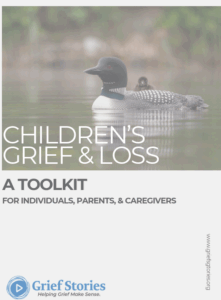
Children’s grief is often misunderstood due to myths about grief. Grief Stories is proud to announce the release of our Children’s Grief Toolkit for individuals, parents, and caregivers. This toolkit curates our content by healthcare professionals and those who experienced the death of a loved one between the ages of 6-12. It is our hope that this toolkit will empower adults in a grieving child’s community to support themselves and grieving children in their lives through loss.
Toolkits are becoming increasingly popular as a knowledge translation strategy for disseminating health and wellness information, to build awareness, inform, and change public and healthcare provider behaviour. Toolkits communicate messages to improve health and wellness and in changing practice to diverse audiences, including healthcare practitioners, community and health organizations, and policy makers.
Our children’s grief and loss toolkit pulls together our original multi-media resources about grief into an easy-to-access format which provide helpful information about the grief experience, stories of childhood experiences of loss, and helpful strategies to move through grief. This toolkit has been curated by mental health professionals for other helpers, for individuals, and their networks as they navigate grief and loss together. They are free to download and use. Grief Stories relies on donations to cover many operational costs, including content creation. If you, or someone in your life has found our content or toolkit helpful, please consider making a donation to Grief Stories (suggested amount $10).
You can download our Children’s Grief and Loss Toolkit for Individuals, Parents, and Caregivers HERE
About Grief Stories:
Grief Stories strives for a world where people in grief feel supported and connected. Our charitable nonprofit organization mobilizes the power of human connection through shared stories that help those experiencing grief feel connected, informed, supported, and hopeful. We create free resources about grief for people who are grieving, people supporting those in grief, and helping professionals. Our multimedia content aims to connect people who have been impacted by grief with hope, connection, stories, insights, and information. As a virtual resource, Grief Stories is privately accessible anywhere, anytime as a community health resource. All content is vetted by healthcare professionals.

Children’s Grief and Loss Toolkit (ages 6-12) [FREE Downloadable PDF]
Grief is a natural experience, and is considered one of the most stressful life events a person can experience. 1 in 14 children under the age of 18 will experience the death of someone close to them. Every year, approximately 200 000 children are grieving the death of someone in their extended family or community. Grief doesn’t stay at home: it follows children throughout their life, and into the classroom with 1 grieving child in every other classroom in Canada. When grief impacts a community, support for grievers of all ages is important. Children’s grief is often misunderstood due to myths about grief. Our children’s grief and loss toolkit pulls together our original multi-media resources about grief into an easy-to-access format which provide helpful information about the grief experience, stories of childhood experiences of loss, and helpful strategies to move through grief. This toolkit has been curated by mental health professionals for other helpers, for individuals, and their networks as they navigate grief and loss together. They are free to download and use.
You can download the toolkit here.
What is a Toolkit?
Grief Stories strives to create a free, accessible, diverse, inclusive, on-demand resource, reducing barriers to accurate online information about grief, helping grievers and those who support them using innovative technology. Our toolkits curate our multimedia content into an easy-to-navigate format on different topics, all vetted by healthcare professionals with expertise in grief and loss.
Toolkits are a popular knowledge translation strategy for disseminating health and wellness information, to build awareness, inform, and change public and healthcare provider behaviour. By keeping our content and toolkits free to access, we help individuals feel confident in connecting with and supporting grievers in their life, while at the same time providing accurate information about grief to help grievers make sense of their experience, one story at a time so they feel less alone.
As a virtual organization, we envision a world connected and supported in grief through our free multimedia library of content. Grief Stories relies on donations to cover many operational costs, including content creation. Each donation we receive allows us to share even more stories, helping grief make sense. If you, or someone in your life has found one of the toolkits helpful, please consider making a suggested donation of $10.00.
For less than the price of a premium streaming service, you can help us share our stories even further with those who need them most – helping grief make sense, one story at a time.

Left Out: Enfranchising Children’s Grief and Loss
By: Jessica Milette, MSW, RSW
All human beings have the capacity to grieve: people with intellectual disabilities, those living with a traumatic brain injury, and children of all ages. However, many people can experience disenfranchised grief when someone dies. Disenfranchised grief is generally grief that is not usually openly acknowledged, socially accepted or publicly mourned. Society disenfranchises grief and mourners by not recognizing one or more of the following: the relationship between the deceased and a survivor, the importance/impact of the loss, or the need to be a griever. Despite the fact that 1 in 14 children will experience the death of a parent or sibling in Canada, children are often left out of conversations about death, dying and grief further disenfranchising them.
In this post, we’ll break down some common myths about children’s grief, how they can disenfranchise children who are grieving, and some gentle strategies caring adults can use with grieving children.
Myth: Children do not have the capacity to grieve
Reality: Children do grieve, it just looks different
We grieve because we have a connection to the person who died. In infancy, babies make attachment connections with their caregivers. When children experience a death, or a change in this connection they will grieve. Based on a child’s developmental age and stage, how they express their grief will vary.
Tips:
-
Remember, children can express their grief in more physical ways such as experiencing some regression in milestones, like a child who has slept in their own room for some time may need to cosleep with their parent after a death.
-
Get creative with your child: they may not be able to clearly communicate in words but consider how they can play or create art to help them understand their grief and associated feelings?
Myth: Children should be excluded from memorials, funerals, and/or rituals to honour the deceased because it may be “too upsetting” or they will not “understand”
Reality: Children’s understanding of grief is different than adults. They should be given invitations to engage in rituals to honour the person who died
Children’s understanding about death and dying is more concrete, and becomes more nuanced and abstract as they age. Just like when supporting grieving adults, clear communication and honouring autonomy is important with children. Excluding children from the opportunity to participate in activities that honour the loved one’s memory can further disenfranchise children.
Tips:
-
Talk with your child in age appropriate ways about what to expect and what happens at the memorial ritual ahead of time.
-
Ask them in the days leading up, and on the day of the event if they wish to attend. Build a plan for your child to spend time with supportive loved ones if they wish to not attend the large gathering.
-
Be prepared with things that help your child feel supported, and provide opportunities for breaks to move and play outside during the day if they are becoming overwhelmed.
-
Honouring and remembering a loved one doesn’t stop at the funeral, create ways for you and your child to honour the person who died in ways that feel good to them.
Myth: Grief is a linear process that follows a timeline
Reality: Grief shifts and changes across a person’s lifetime, from childhood to adulthood.
As children move through different developmental ages and stages their understanding of grief evolves . All humans, including children can also experience regrief when they meet a milestone after their loved one has died.
For example, a child who had a parent die when they were 9, may experience intense grief reactions as they prepare to graduate from school, learn to drive a car, or have their own children.
Society also attempts to regulate how, when, and how long people may grieve. Suffocated Grief, a term coined by grief expert Tashel Bordere speaks about how a griever can feel punished for their natural expressions of grief. Children can be disenfranchised by teachers, being punished for physical reactions of their grief by being called “disruptive” and being sent to the office for discipline.
Tips:
-
When a child in your life is displaying atypical behavioural patterns, think about – could this be grief from earlier in their life showing up?
-
Continuing to share stories about the person who died with grieving children across their lifespan, creating space to ritualize them, and validating their emotions is important.
Myth: Children should be spared from seeing adults in their lives expressing their painful grief emotions
Reality: It’s important that children see others in their life grieving, and be validated that it’s okay to feel sad, mad, or any other emotion they are experiencing
Grieving adults are also facing deep pain, and we are often taught by society to keep it behind closed doors. Letting children in our life see us feeling sad, and coping with our grief in healthy ways role models to children that it is natural to feel and express grief with people who are caring.
Tips:
-
It’s okay to let a grieving child see a grieving adult feel sad or mad. You can let the child know that grief is natural and we can have different emotions because we miss the person who died.
-
Caregivers need care too. Consider exploring finding your own sources of support in addition to creating opportunities to share with your child about grief, such as using your own support network, exploring therapy, or joining a caregiver and child grief support group.
About Jessica Milette, MSW, RSW:
Jessica Milette is a passionate community-focused grief advocate, fostering change through a culture of collaboration, lifelong learning, best practices, and creativity to build a brighter and kinder future.
Jessica joined the Grief Stories Operations team in 2023, bringing over 15 years of experience providing grief and mental health peer support, in addition to being a registered social worker, practicing since 2018.
Jessica believes in the power of connection; within ourselves, with those who have died, those we are in relationship with, and with our greater communities. Through sharing our stories of grief and loss, we tend to our connection with those who have died and create meaningful connections with others.
Jessica is a white neurodivergent woman living on the traditional territory of the Anishnabek, the Haudenosaunee, the Attiwonderonk, and the Mississaugas of the Credit peoples, also known as Guelph, ON.